|
NOTE: Please acknowledge the authorship of these
program notes by Jose Elizondo, the composer, if you use them for publicity
material, concert program notes, or any other publication. |
|
|
·
·
·
·
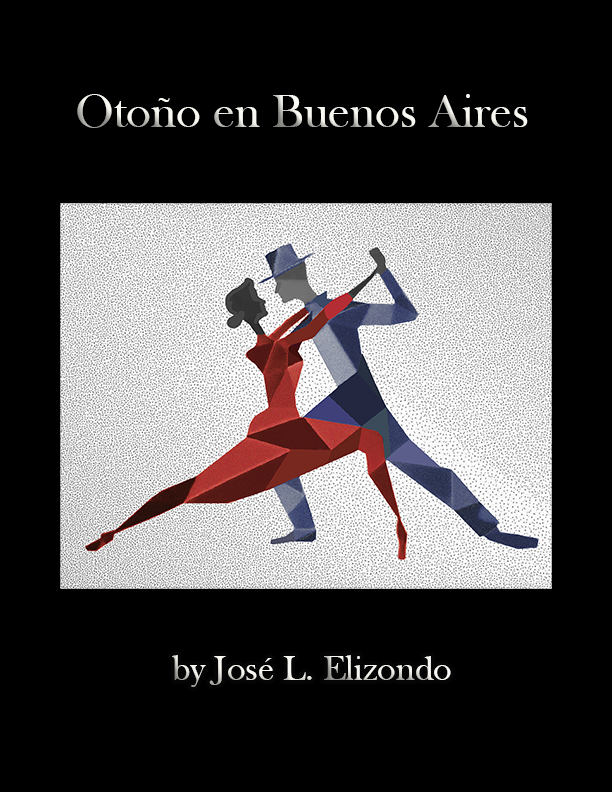
Otoño en Buenos Aires
·
from “Danzas Latinoamericanas”
·
|
|
|
|
|
·
Commission: Commissioned by and
dedicated to Mexican cellist Carlos Prieto ·
Duration: Approximately 4 minutes
(depending on the version) ·
Mood: Latin, energetic,
passionate, high-energy |
|
|
·
Description: Otoño en
Buenos Aires is the first
movement of the suite titled “Danzas Latinoamericanas”.
It’s a tango inspired by the music of Astor Piazzolla and Carlos Gardel. |
|
|
|
|
|
Program Notes by José Elizondo: THE COMMISSION In
1996, Mexican cellist Carlos Prieto returned to his alma mater, the
Massachusetts Institute of Technology (MIT), to present a series of recitals
and lectures. After one of those concerts, I had the privilege of meeting
him. To my great surprise, he asked me to compose a piece for two cellos. He
granted me complete freedom regarding the length and content of the piece and
mentioned that he planned to perform a concert with Maestro Yo-Yo Ma in the
near future, where he would be delighted to play my composition. The
prospect of having two of my musical idols perform my music was both
exhilarating and intimidating. At that time, I had never written anything
significant for the cello and hadn’t played any string instruments myself.
Determined to rise to the challenge, I embarked on an intensive self-taught
study of Bach’s cello suites. I composed a series of short dances in the
Baroque style. Initially, I viewed those as mere learning exercises, but
these “Baroque Dances” were later premiered by Maestro Carlos Prieto in duet
with Maestro Álvaro Bitrán. Regarding
the original commission, several factors influenced my decision to infuse the
music with a Latin American flavor. During that period, I was captivated by
the works of composers such as Astor Piazzolla and Heitor Villa-Lobos. I
immersed myself in studying their compositions and aimed to create music that
paid homage to these great artists. I
didn’t want to produce a piece that merely referenced or overly stylized
elements of Latin American music. Instead, I aspired to compose music that
“tasted” like actual tango, bossa nova, and Mexican folkloric dance—music
that could be both played and danced authentically. I drew significant
inspiration from Maestro Yo-Yo Ma’s enthusiasm for music from diverse
cultures and Carlos Prieto’s passion for Latin American music. FIRST
MOVEMENT: “OTOÑO EN BUENOS AIRES” After
immersing myself in countless tangos by Piazzolla and the legendary Carlos
Gardel, I began composing “Otoño en Buenos Aires” (Autumn in Buenos Aires), which would
eventually become the first movement of the piece I presented to Maestro
Carlos Prieto. My initial goal was for the two cellos to converse and
interact in a manner akin to a couple dancing tango. I aimed for the melodies
to capture the dramatic contrasts characteristic of Gardel’s tangos. I
intended for this work to be performed in the tradition of tango performance,
which is a departure from the sensibilities of European concert music. This
tradition involves an expressive use of tempo, with sometimes subtle and
sometimes dramatic modifications that follow the push and pull of the tango
dance. My hope was to create music that genuinely embodied the spirit of
tango. [For
program notes about the second and third movement, please see the program
notes for “Danzas Latinoamericanas”] PERFORMANCES Carlos
Prieto received the work with great enthusiasm. One of the most memorable
performances was when Maestro Prieto played “Otoño en Buenos Aires” in a duet with Maestro Yo-Yo Ma at Sala Netzahualcóyotl in Mexico City. A recording of “Otoño
en Buenos Aires” by Maestro Yo-Yo Ma and Maximilian
Hornung in 2016, as well as several performances of “Danzas Latinoamericanas” by British cellist Sheku Kanneh-Mason,
with Guy Johnston and Ashok Kouda, in several of their concerts in 2018 and
2020 also significantly contributed to the work’s popularity. To
date, “Latin American Dances” has been performed in over 1,500 concerts
across more than 75 countries. In addition to maestros Carlos Prieto, Yo-Yo
Ma, Sheku Kanneh-Mason, and Guy Johnston, this work has been performed by
distinguished artists such as Álvaro Bitrán, James
Buswell, Andrei Ioniță (winner of the 2015 Tchaikovsky Competition), Yibai Chen (2nd prize, 2022 Queen Elizabeth Competition),
Hrachya Avanesyan (winner of the 2006 Yehudi Menuhin and the 2008 Carl
Nielsen competitions), Han Bin Yoon, Olsi Leka, Joe Wan, James Baik, Eugene
Lin, Joseph Zeitlin, Nan-Cheng Chen, Sophie Shao, Maximilian Hornung, Eunghee Cho, Alexandra Soumm,
Sébastien Hurtaud, Marc
Sabbah, Aurélien Pétillot, among others. It has
also been performed by more than 250 orchestras, including the China
Philharmonic, the Cuenca Symphony in Ecuador, the Moravian Philharmonic, the
Malaysian Philharmonic, the Houston Symphony, and the Macau Orchestra. Other
recent memorable performances include a concert that took place on December,
2023, when the orchestral version, conducted by Maestro Jorge Soto, was
performed at the Isaac Stern Auditorium at Carnegie Hall in New York, and a
concert on February 2024, when the string quartet version was performed at
the Berlin Philharmonic Theater. |
|
|
|
|